What Is All of It For?
I read a book this summer that changed the way I see the world - and what I believe our purpose on earth as humans might be. I can’t stop thinking about it.
As I write these words, I’m sitting at a small table outside an old brick coffee shop at the edge of a long, leafy promenade. It’s a couple degrees warmer than perfect, but there’s a light breeze. Thick Southern voices drift around me from a motley mix of locals exchanging greetings:
“How ya doin’, huunny?”
“Hh, mah little sweet-h’at.”
“You take good care ‘a ya-self, ya hear me, baaaby?”
This is Columbus, Georgia, a stone’s throw across the river from Alabama. I’m glad mass media and modern culture haven’t yet totally homogenized the distinctiveness of the Deep South (and many other singular places across America).
By now, you’ve probably already heard of (or read) Theo of Golden. The book was inspired by this very coffee shop, whose walls are lined with ninety-two pencil portraits of people from the community, drawn by a local artist (I could’ve spent all afternoon silently studying each one, a delicate composition of light and shadow and simple shapes rendering even the tenderest subtleties of suffering, hope, joy, and longing; I was as mesmerized as Theo).
So when a work trip brought me to Atlanta for a few days, I knew I had to make the two-hour pilgrimage down here.
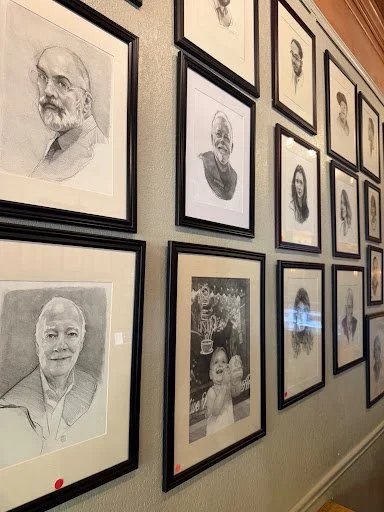
I’ve told you before about my Grandma Jan teaching me and my siblings to draw from the time I was five or six, an interest that has continued in earnest ever since.
At her cluttered kitchen table, I discovered my own blindness.
Trying to capture even the simplest of subjects with pencil on paper forced me to notice things I simply never saw before: the relationship between light and shadow, the simple shapes hiding inside the most complex objects, the edges and space around a subject - what artists call “negative space” - that sometimes helps you see the thing itself more clearly.
Grandma was teaching me to draw, but really, I was learning to see - at least a few degrees better than I did before. It’s a lifelong pursuit.
That gift has proven perhaps the single most valuable tool I have in finding opportunities, creating places, and, yes, drawing pencil portraits for my friends.
But reading this little book, something unlocked deep inside; or more accurately, something broke open. I was - I am - deeply convicted by what I encountered, and inspired. And I believe the message applies to every one of us, one way or another.
We’re all artists, whether we realize it or not.
Some of us make paintings or drawings. Others shape buildings, businesses, spreadsheets, classrooms, meals, families, friendships, words. Creating and shaping is a beautiful birthright we share as humans.
But what is all of it for?
Is our art ultimately just about us? So people will see what we can do? So we can be admired? I struggle with this constantly, as touched on last week.
As a Christian, I’ve pretty much always believed that my life and work should all point beyond myself and glorify God. But Theo of Golden opened my eyes to something more clearly.
What if the highest and best use of our ability to see beauty is helping someone else see the beauty that’s around them - or in them?
Maybe art is ultimately not about being seen as an artist.
Maybe art is about helping someone else see.
A portrait can do that, but so can a conversation, a thoughtful question, even a smile.
For me, place has become such a clear expression of this calling. I increasingly believe that every one of us shares, in some form, a ministry of place: our homes, yards, neighborhoods, workplaces, communities, and cities.
It is easy to romanticize greener grass somewhere else, but really we just remain (or become) blind to the opportunities hiding before our eyes.
This place where I am sitting right now inspired a novel that has gone on to inspire millions of readers. And after sitting here for the past hour, I can assure you, the description of it in the book is better :).
But that gives me even more hope.
There are countless corners of the world just like this one - “normal” places - each carrying its own distinctive treasures of beauty and inspiration, waiting for someone to notice what might be possible there.
Waiting, perhaps, to help someone see something they never have before.
May we use whatever gifts we’ve been given to help other people see the beauty and the good they have become blind to. And may even the painful things we go through only sharpen that vision rather than darken it.
—isaac
P.S. If you haven’t read Theo of Golden yet, I’m told the audiobook is pretty great, too.